
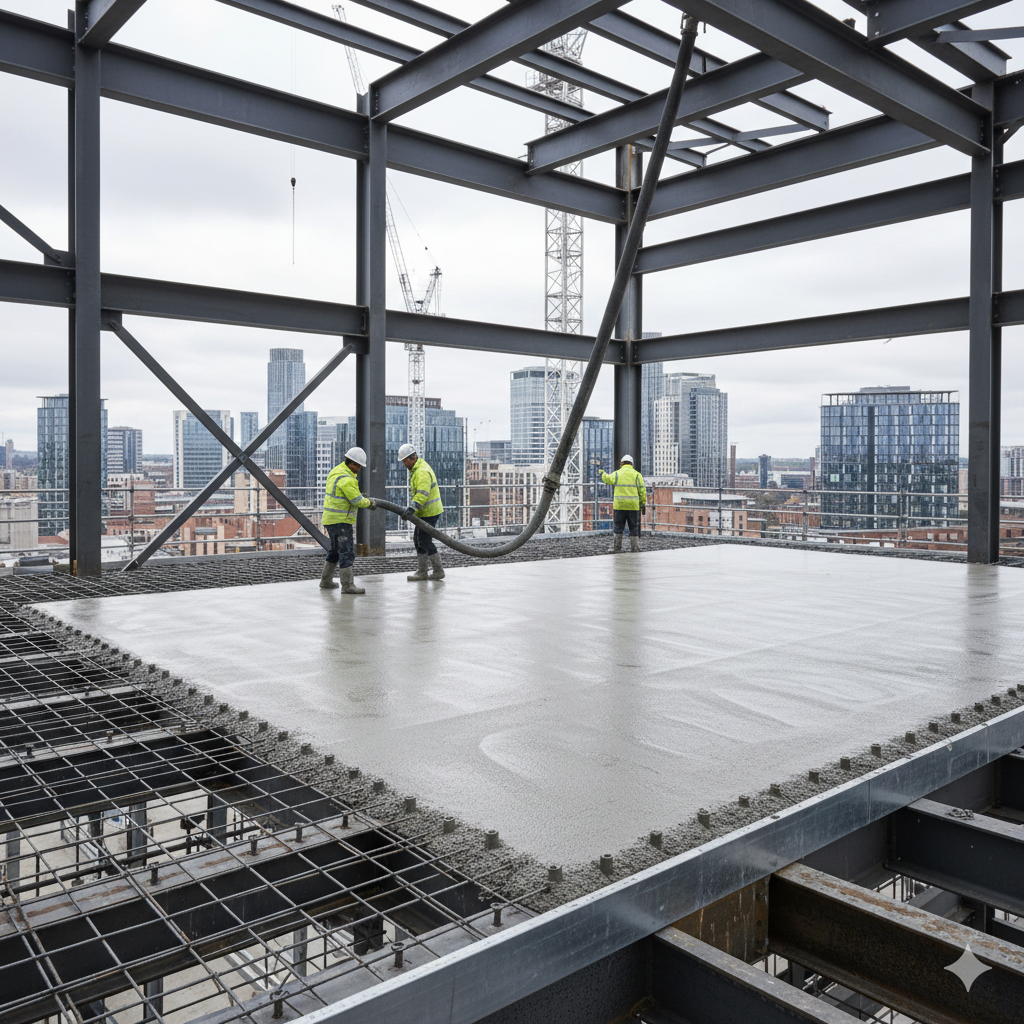
Manchester is growing fast. New offices, apartment blocks, warehouses, and retail spaces are rising across the city. Many of these buildings have one thing in common; they use steel frames and composite flooring systems. And at the centre of those systems is metal decking concrete Manchester.
At Flowing Floors Ltd, experts work on projects where strength, speed, and accuracy matter. Metal decking concrete is not just about pouring concrete. It is about planning properly, working safely, and delivering floors that perform for decades.
In this guide, we’ll walk you through the full journey — from early design to final curing — in a simple and practical way.
What Is Metal Decking Concrete?
Metal decking concrete is a flooring system used mainly in steel frame buildings.
It works like this:
1. Steel beams form the main structure.
2. Metal deck sheets are fixed across the beams.
3. Shear studs are welded to the beams.
4. Reinforcement mesh is placed.
5. Concrete is poured on top.
Once the concrete sets, the steel and concrete work together as one strong structural floor. This is called a composite slab.
This system is popular in Manchester because it is fast, efficient, and reliable.
Why Manchester Projects Use Metal Decking
Manchester construction sites often face tight deadlines and limited space. Many sites are in busy city centre locations. There is little room for delays.
Metal decking concrete Manchester systems help solve these problems because they:
1. Speed up installation
2. Reduce the need for temporary supports
3. Lower overall building weight
4. Work perfectly with steel frames
5. Allow faster floor-by-floor progress
For multi-storey buildings, this speed is a big advantage.
Step 1: Planning and Design
Every good floor starts with good planning. Before any materials arrive on site, engineers decide:
1. How much weight the floor must carry
2. How far the slab needs to span
3. What thickness the slab should be
4. Where reinforcement is needed
5. Fire rating requirements
The type of metal deck is also chosen during this stage. Different profiles are used depending on load and span.
Good planning prevents mistakes later. It also keeps the project on schedule.
Step 2: Installing the Steel Frame
Before decking can begin, the steel frame must be in place. Steel beams are lifted and fixed into position. They must be level and aligned correctly. Even small errors at this stage can affect the floor later.
In Manchester, this stage often needs careful coordination. Deliveries must be timed well. Cranes must be booked. Safety rules must be followed closely.
Once the frame is secure, decking can start.
Step 3: Laying the Metal Decking
Metal deck sheets are lifted onto the steel beams and fixed in place. These sheets act as permanent formwork. This means they hold the wet concrete during the pour. But they also become part of the finished structure.
The deck must be:
1. Laid straight
2. Fixed securely
3. Properly supported
4. Fitted with edge trims
Edge trims are important. They stop the concrete from spilling and help shape the slab edges.
Accuracy here makes everything easier later.
Step 4: Welding Shear Studs
Shear studs are small steel connectors. They are welded through the metal deck onto the steel beams.
These studs are very important. They lock the concrete slab to the steel frame. This allows the steel and concrete to act together as one strong structure.
Without shear studs, the slab would not perform properly.
Stud welding must be done carefully. Each stud must be secure and positioned correctly.
Step 5: Placing Reinforcement
After stud welding, reinforcement mesh is added. The mesh strengthens the slab and helps control cracking.
Spacers are used to lift the mesh to the correct height. If reinforcement sits too low or too high, the slab may not perform as designed.
This stage may look simple, but attention to detail matters.
Step 6: Choosing the Right Concrete
Now we come to one of the most important decisions — the concrete mix. Many projects today choose self compacting concrete Manchestersolutions. Self compacting concrete, also called SCC, flows easily without the need for vibration.
This brings several benefits:
1. Faster pouring
2. Less labour
3. Better surface finish
4. Reduced air pockets
5. Quieter working environment
On busy Manchester sites, reducing noise and equipment is a big advantage.
SCC is especially useful on metal decking because it flows smoothly around shear studs and reinforcement. This reduces the risk of voids.
Step 7: The Concrete Pour
Pour day must be well organised. Before pouring starts, the team checks:
1. Deck fixings
2. Reinforcement position
3. Stud welding
4. Edge trims
5. Access routes for pumps
Concrete is then pumped onto the deck and spread evenly.
If using self compacting concrete Manchester, the mix spreads naturally. There is no need for mechanical vibration.
This makes the process faster and safer.
The slab must be poured to the correct depth. Laser levels or depth markers are often used to maintain consistency.
Step 8: Finishing the Surface
After pouring, the surface is levelled. Depending on the project, the slab may need:
1. A smooth power-floated finish
2. A basic structural finish
3. Preparation for screed or flooring systems
The finish depends on the building’s final use.
For example, industrial units may need a tough finish. Office spaces may later receive raised access floors.
Step 9: Curing the Concrete
Curing is one of the most overlooked steps. Concrete does not simply “dry.” It gains strength through a chemical reaction called hydration. If the slab dries too quickly, it can crack.
To prevent this, the slab must be protected. This may include:
1. Applying curing compounds
2. Covering with protective sheets
3. Controlling moisture loss
Full structural strength usually develops over 28 days.
Why Self Compacting Concrete Is Becoming Popular in Manchester
More developers are choosing self compacting concrete Manchester because it saves time and improves quality.
Here’s why:
1. No vibration equipment needed
2. Reduced labour on site
3. Better flow around reinforcement
4. Lower risk of voids
5. Improved safety
In city-centre Manchester, where space is tight and safety is key, these benefits matter.
Common Challenges on Manchester Sites
Every site is different. But common challenges include:
Limited Access
City projects often have tight entry points and restricted working areas.
Weather Conditions
Rain and temperature changes can affect pouring and curing.
Tight Deadlines
Developers want fast turnaround times.
Trade Coordination
Metal decking must align with M&E services and structural design.
Experience helps manage these challenges smoothly.
Why Experience Makes the Difference
Metal decking concrete Manchester projects may look simple on paper. But success depends on careful execution.
An experienced team ensures:
1. Decking is installed correctly
2. Stud welding is secure
3. Reinforcement is accurate
4. Concrete is poured evenly
5. Curing is handled properly
Small mistakes can cause big problems later. That is why working with specialists matters.
Final Thoughts
From the first design drawing to the final cured slab, metal decking concrete is a process that requires planning, precision, and teamwork.
Manchester continues to grow. Steel frame buildings are becoming the norm. And composite flooring systems are helping projects move faster and perform better.
When combined with self compacting concrete Manchester solutions, these floors offer strength, efficiency, and long-term reliability.
Done properly, they create solid foundations for modern buildings across the city.
Frequently Asked Questions
What is metal decking concrete?
It is a composite floor system where steel decking acts as permanent formwork and combines with reinforced concrete to create a strong slab.
Why is metal decking concrete popular in Manchester?
It speeds up construction, reduces structural weight, and works well with steel frame buildings.
What is self compacting concrete?
Self-compacting concrete is a highly flowable mix that spreads without vibration. It improves finish and reduces labour.
Is self compacting concrete Manchester suitable for composite slabs?
Yes. It flows easily around reinforcement and shear studs, making it ideal for metal decking systems.
How long does metal decking concrete take to cure?
Concrete begins to set within hours but usually takes around 28 days to reach full structural strength.
Is metal decking concrete cost-effective?
Yes. It often reduces labour, speeds up programmes, and improves structural efficiency, making it a smart choice for many Manchester projects.